

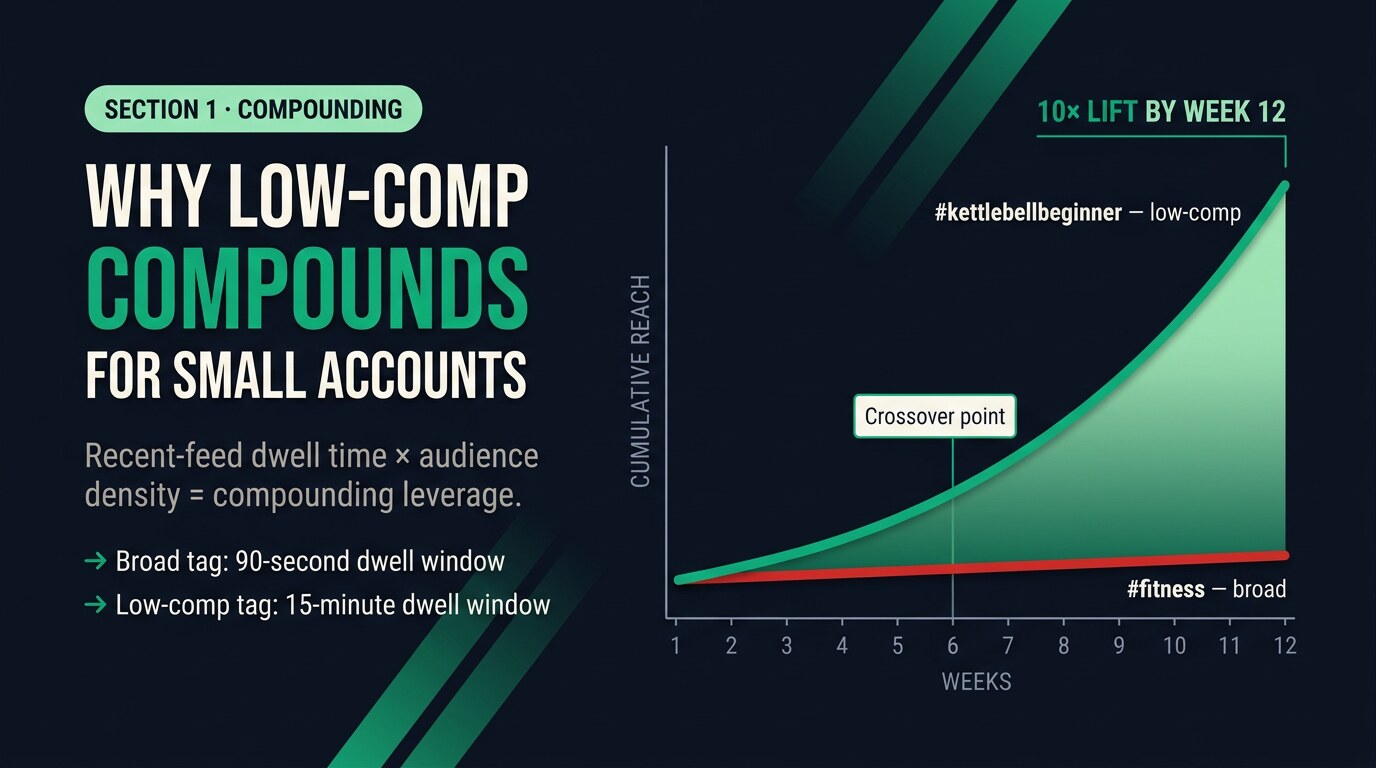
The same fitness Reel posts twice. Once with #fitness in the set — competing against four hundred million other posts — and once with #kettlebellbeginner, competing against twelve thousand. Same content, same caption, same time of day. The second version out-reaches the first by an order of magnitude every time. That's the low-competition compounding effect, and for any account under a million followers it's the single most underused growth lever on the platform.
This post is the working 2026 playbook for finding low-competition hashtags that actually rank — the math behind why they compound, the two metrics that separate a genuine hidden gem from a dead tag, four methods to find them, thirty niche examples, and the verification check that stops you deploying a tag that looks low-competition but isn't.
Quick answer
A genuine low-competition Instagram hashtag has under 50,000 total posts and at least 100 weekly active posters. The first metric means small accounts can actually rank in the recent-posts feed; the second means there's an audience watching the feed. Tags that hit both criteria compound for small accounts because the algorithm uses your post to test the hashtag's audience — and without competition, your post stays on top long enough to earn the impressions.
What's in this post
Why low-competition hashtags compound
Instagram's hashtag-feed pages work on a recency-weighted relevance score. New posts that match the hashtag get shown to a small test audience pulled from the people who follow or watch that tag's content. If the test audience watches, saves, or shares the post at a higher-than-baseline rate, the algorithm expands distribution. If the test audience scrolls past, distribution stalls.
The friction for small accounts on a broad hashtag like #fitness is the recency window. Fitness sees roughly 800 posts per minute. Your post sits on the recent-feed for maybe 90 seconds before being pushed off the top by 1,200 newer posts. That's barely enough time for the test audience to find it. On #kettlebellbeginner, which sees maybe 4 posts per hour, your post sits on the recent-feed for 15 minutes — long enough for the entire small-but-engaged niche-community audience to watch it, save it, and feed positive signals back to the algorithm. The compounding math works in your favour because the audience density per post is dramatically higher.
The 2 metrics that matter
Total post count is the easy metric — visible on every hashtag's feed page. Weekly active posters is the hidden second metric that separates a hidden gem from a dead tag. A hashtag with 8,000 posts that hasn't seen a new post in three months looks low-competition but earns nothing because the audience has migrated. A hashtag with 8,000 posts and 200 new posts per week is the gem.
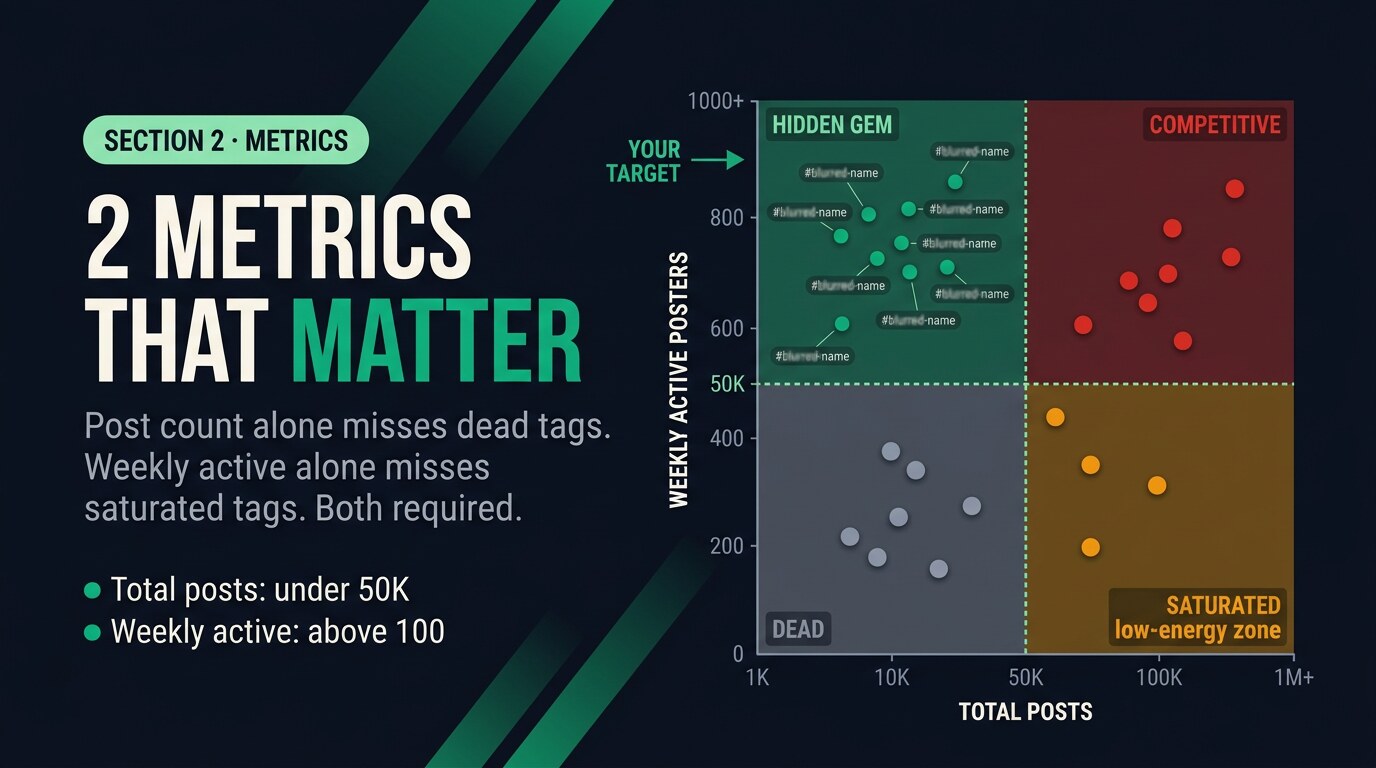
The sweet spot is the third bracket: under 50K total posts and at least 100 new posts per week. Both conditions are necessary. A 30K-post tag with five posts last week is a graveyard. A 30K-post tag with 300 posts last week is a feeding ground.
4 methods to find low-comp tags
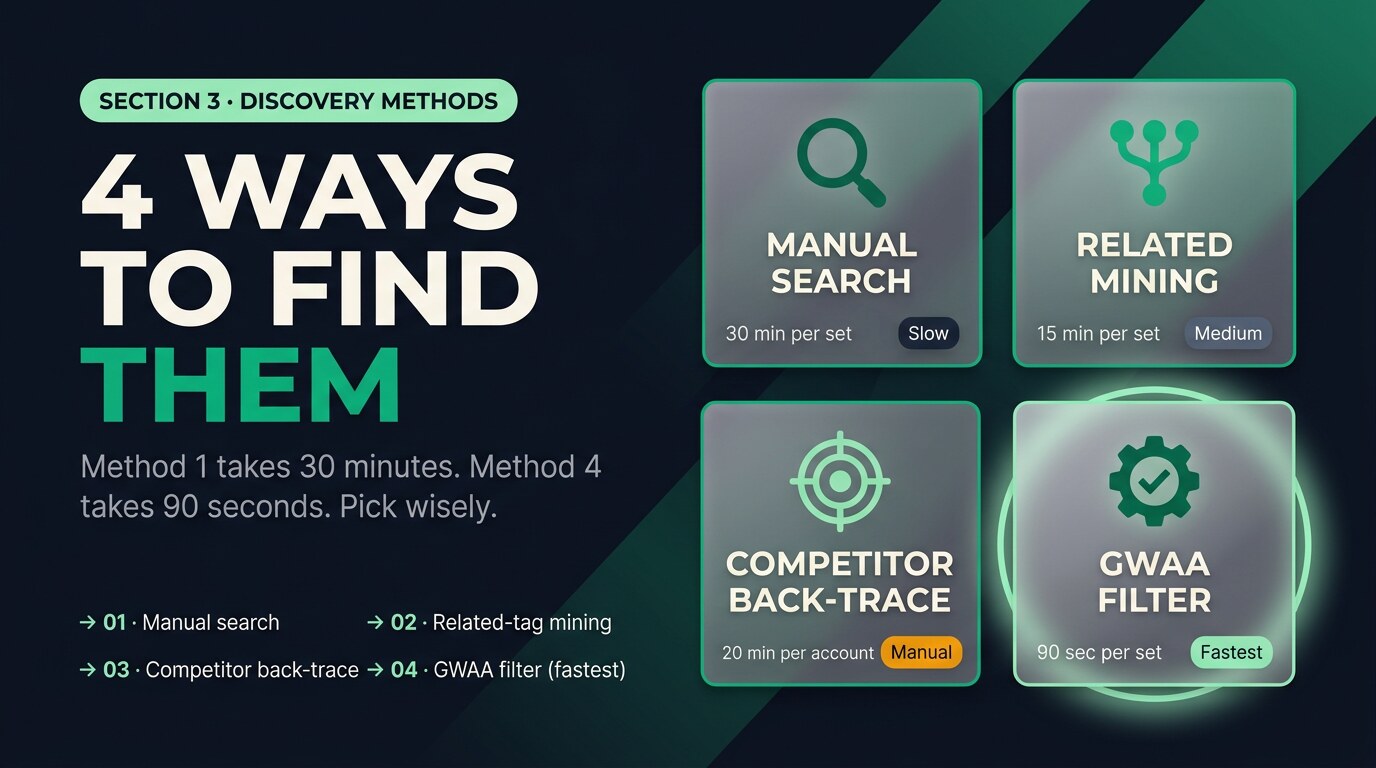
Four working methods. Each has a different effort-to-yield ratio. Use the fourth if you value your time.
Manual hashtag-page search
Most thorough — type a niche term into Instagram’s search, scroll the hashtag results, manually check post-counts and recent activity for each candidate.
Pros
- Most accurate — you see the live feed
- Free, no tools required
- Teaches you the niche while you search
Cons
- 30 minutes per working set of ten
- No batch view, no automation
- Easy to miss adjacent tags
Verdict
Slow but reliable. Use when you’re entering a new niche and want to learn the landscape, or to fact-check a tool’s output.
Related-tag mining
Quick browse — open any tag’s feed page; Instagram shows a "Related" carousel of semantically close tags. Scroll, note post-counts, save the qualifying ones.
Pros
- Faster than manual search
- Surfaces tags you wouldn’t think of
- Free, in-app
Cons
- Misses tags Instagram doesn’t surface
- Carousel rotation hides depth
- No weekly-active metric
Verdict
Solid for an extra-five-tag pass after the main set is locked. Don’t rely on it as the only method — the Related carousel is curated, not exhaustive.
Competitor back-trace
Validation method — find three accounts in your niche with similar follower-count but better engagement. Pull their last 20 posts, list every hashtag, count frequencies. Tags that appear repeatedly with low post-counts are validated picks.
Pros
- Pre-validated by working accounts
- Captures niche-specific vocabulary
- Reveals competitor strategy
Cons
- 20 minutes per account researched
- Requires finding the right accounts first
- Misses tags the competitors haven’t tried yet
Verdict
The highest-confidence method. The tags it surfaces are already proven to work for accounts like yours. Worth the effort once per quarter to lock in a tested baseline.
GWAA filter (fastest)
Best for verified low-comp — the hashtag generator has a built-in low-competition filter that returns only tags meeting both the post-count and weekly-active thresholds. 90 seconds to a verified set of ten.
Pros
- Both metrics enforced automatically
- Live-volume queried at request time
- 90 seconds to a working set
- Free, no login
Cons
- Newer tool — smaller historical-trend dataset
- Filter assumes the standard <50K / 100+ thresholds
Verdict
The fastest workflow with the cleanest output. Try it first — fall back to the manual methods only if the niche is too small for the filter to return enough tags.
GWAA tool walkthrough
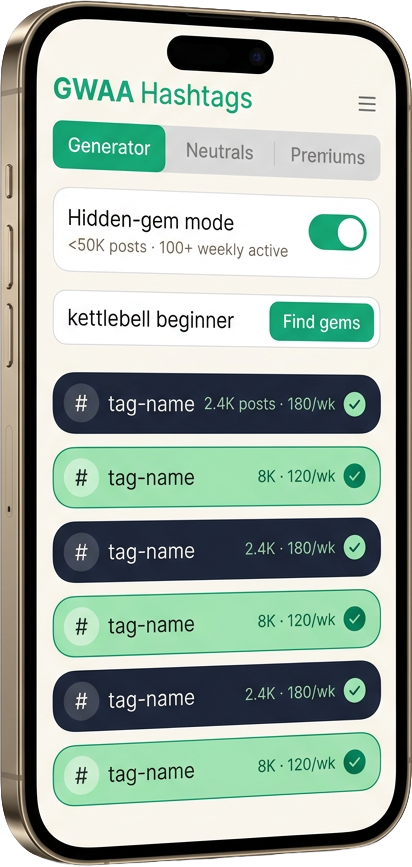
The five-step low-competition filter workflow inside the generator. Each step takes under 20 seconds.
Input your niche
Type one-to-three descriptive words for your post's specific subject — "kettlebell beginner workout" rather than "fitness".
Toggle low-comp filter
Turn on the "Hidden-gem mode" toggle. Post-count cap defaults to 50K; weekly-active floor defaults to 100.
Read the result
The tool returns 8-15 tags that pass both thresholds, each annotated with post-count + weekly-active + sample-recent-post snapshot.
Verify your top picks
Click any tag to open its live hashtag-feed page in a new tab. Confirm the recent posts look like a real audience, not bot accounts.
Save the verified set
Once you've confirmed three to five solid picks, save them to your personal hashtag library. Re-verify the set monthly — niche-maturity shifts.
30 low-competition tags by niche
Thirty tags across seven niches that met both low-comp criteria at publish time. Treat as starting points — niche-maturity shifts so verify in the generator before deploying any of them in a campaign.

| Niche | Hidden-gem hashtags |
|---|---|
| Fitness | #kettlebellbeginner · #homeglutework · #mobilityroutine · #fitnessover40diary |
| Food | #weeknightsourdough · #onepanbreakfast · #sheettrayrecipes · #oatmilkbakes |
| Fashion | #thrifteddenim · #neutralcoreaesthetic · #linenwardrobe · #vintagestyleicons |
| Travel | #lesserknownitaly · #weekendcoastaltrip · #soloeuropetrip · #hiddengemsofeurope |
| Beauty | #oilyskinroutineplan · #cleanbeautyswaps · #drugstoreglowup · #lipcomboideas |
| Finance | #etfportfolioplan · #sidehustleuk · #emergencyfundgoals · #indexfundbasics |
| Small business | #handmadeceramicsuk · #etsysmallshop · #womenownedworkshop · #shopsmallhandmade |
The pattern across niches: low-comp tags are almost always compound words that combine a specific subject + a modifier (audience, geography, format, or goal). #kettlebellbeginner = subject + audience. #weeknightsourdough = subject + format. #lesserknownitaly = subject + modifier. Once you see the pattern you can generate candidate tags directly — then verify each one before locking it in.
4 hashtag-research tools, reviewed
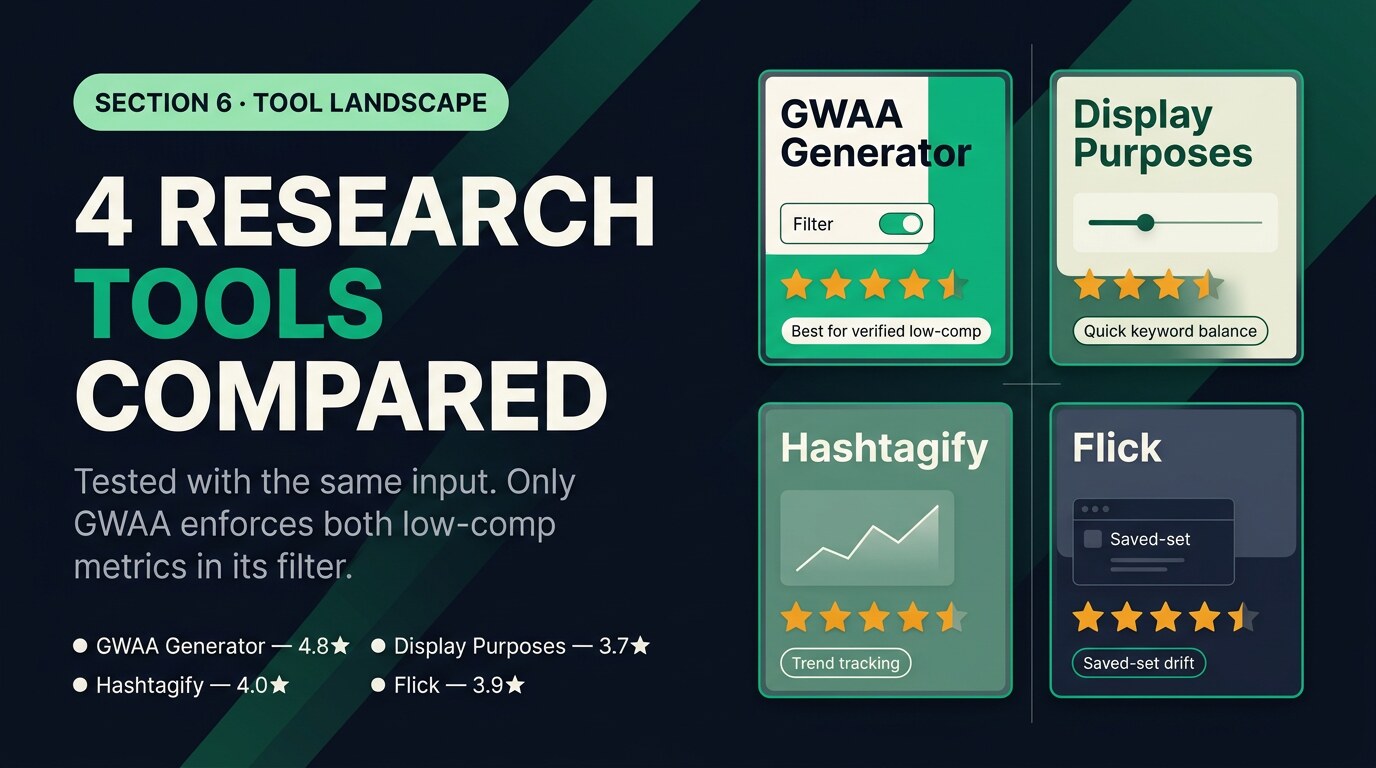
Four tools that surface low-competition hashtags. We tested each on the same input ("kettlebell beginner workout") and compared the quality of the returned sets.
GWAA Hashtag Generator
Best for verified low-comp — the only free tool with a true low-competition filter that enforces both post-count and weekly-active thresholds.
Pros
- Both metrics enforced in the filter
- Live-volume queried at request time
- Free, no login
- Banded result includes a low-comp band by default
Cons
- Newer tool — smaller historical-trend dataset than Hashtagify
Verdict
The fastest workflow with the most accurate filter. Try it.
Display Purposes
Quick keyword balance — the long-running tool offers an engagement-vs-reach slider that biases toward smaller tags when you push it.
Pros
- Slider biases toward niche size
- Free, simple
Cons
- No weekly-active metric
- Returns include dead tags below the activity floor
Verdict
Decent for a quick suggestion list but you'll still need to verify activity manually.
Hashtagify
Historical trend data — Hashtagify's strength is showing the popularity-over-time graph for any tag, which catches niche-maturity drift before it tanks your set.
Pros
- Multi-year trend graphs per tag
- Related-tag network mapping
Cons
- Most useful features paywalled
- No native low-comp filter — you read the graphs and judge
Verdict
Worth a free trial if you care about long-term tag-health trends.
Flick
Saved-set management — Flick's subscription product manages saved hashtag sets across multiple accounts and flags tags that drift out of the low-comp band over time.
Pros
- Saved-set drift detection
- Multi-account workflow
Cons
- Subscription only
- Overkill for solo creators
Verdict
Worth the subscription for agencies running 10+ accounts with active hashtag rotation.
How to verify a tag is genuinely low-comp
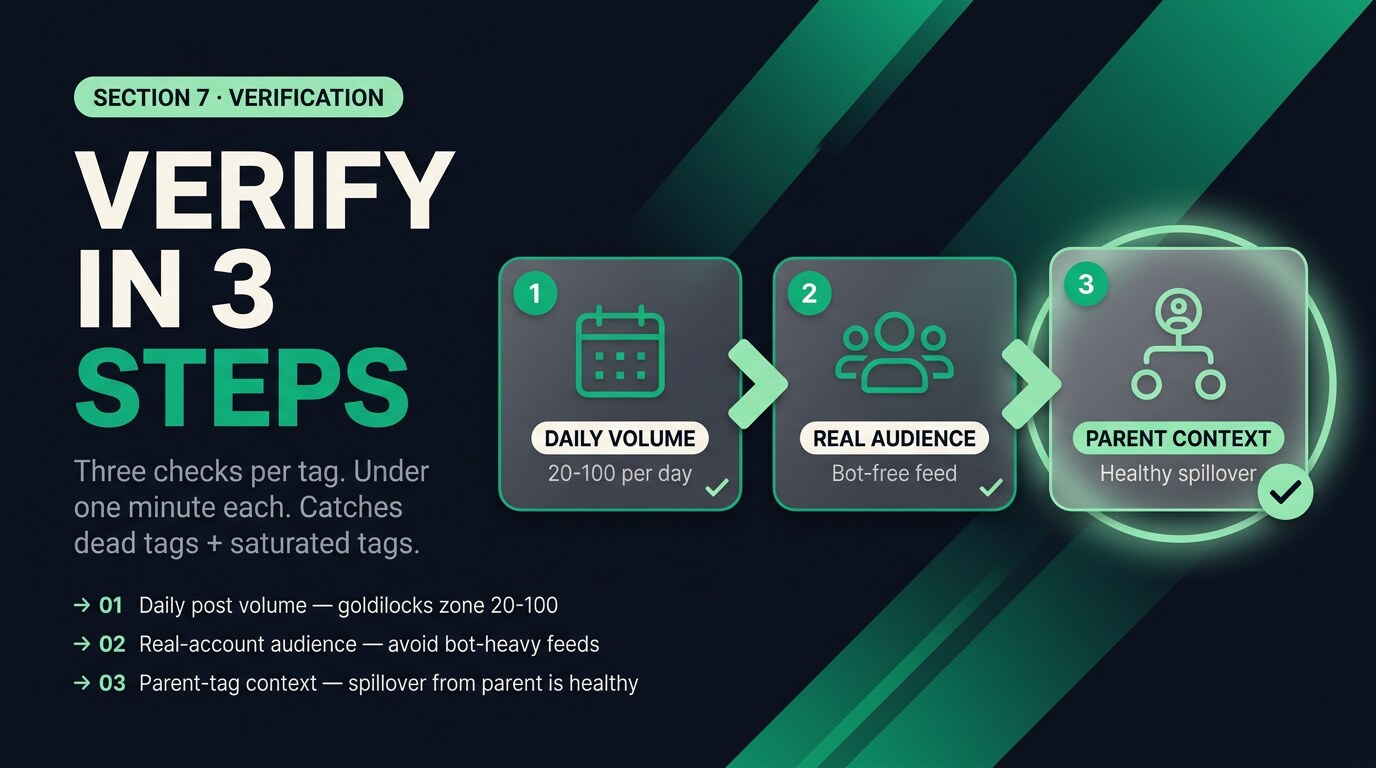
Verification is the step most creators skip. A tag that LOOKS low-competition based on post-count alone can be a dead tag (nobody watching) or a recently-saturated tag (the field moved). Three checks per tag, under one minute each.
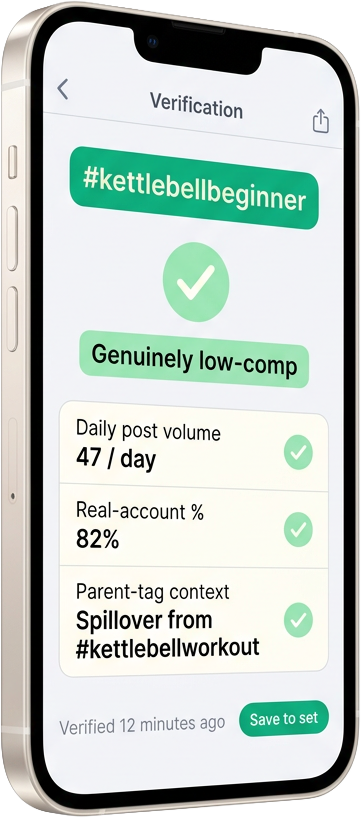
Step one: open the tag's hashtag-feed page directly in the app. The very top should show a "Recent" tab; scroll the recent posts and count how many were posted in the last 24 hours. Below ten = the tag is too quiet; above two hundred = it might already be saturating. Twenty to a hundred per day is the goldilocks zone for a genuine hidden gem.
Step two: look at the accounts posting under the tag. If three out of the first ten posts are obvious bot accounts (zero followers, identical caption pattern, no profile photo), the audience watching the tag is also bot-heavy — reach earned there is hollow. Real accounts in the recent feed = real audience watching.
Step three: cross-reference the tag against the broader niche. If #kettlebellbeginner looks low-comp but #kettlebellworkout (the parent broader tag) is saturated, the audience on the child tag is probably real spillover from the parent. If both parent and child are quiet, the niche itself may be the issue and a different niche-band tag is the better pick.
Low-competition isn't small audience — it's the audience nobody else is competing for. That's compounding leverage.
5 takeaways
- Genuine low-comp = under 50K posts and 100+ weekly active posters. Both conditions necessary.
- Compounding leverage works for small accounts because recent-feed dwell time is dramatically higher on small tags.
- The naming pattern is subject + modifier. Once you see it you can generate candidates directly.
- Always verify a tag with three checks: daily post volume, real-account audience, parent-tag context.
- Re-verify your locked sets monthly — niche-maturity drifts in both directions.
Find your hidden-gem hashtags in 90 seconds
Type your niche into the GWAA generator and flip the Hidden-gem filter. Both low-comp metrics enforced, verified against the live feed, banded result ready to copy.
Open the GWAA Hashtag GeneratorRelated reads: Best Instagram hashtags for Reels in 2026 · How many hashtags should you use · Why your hashtags aren't getting reach


